


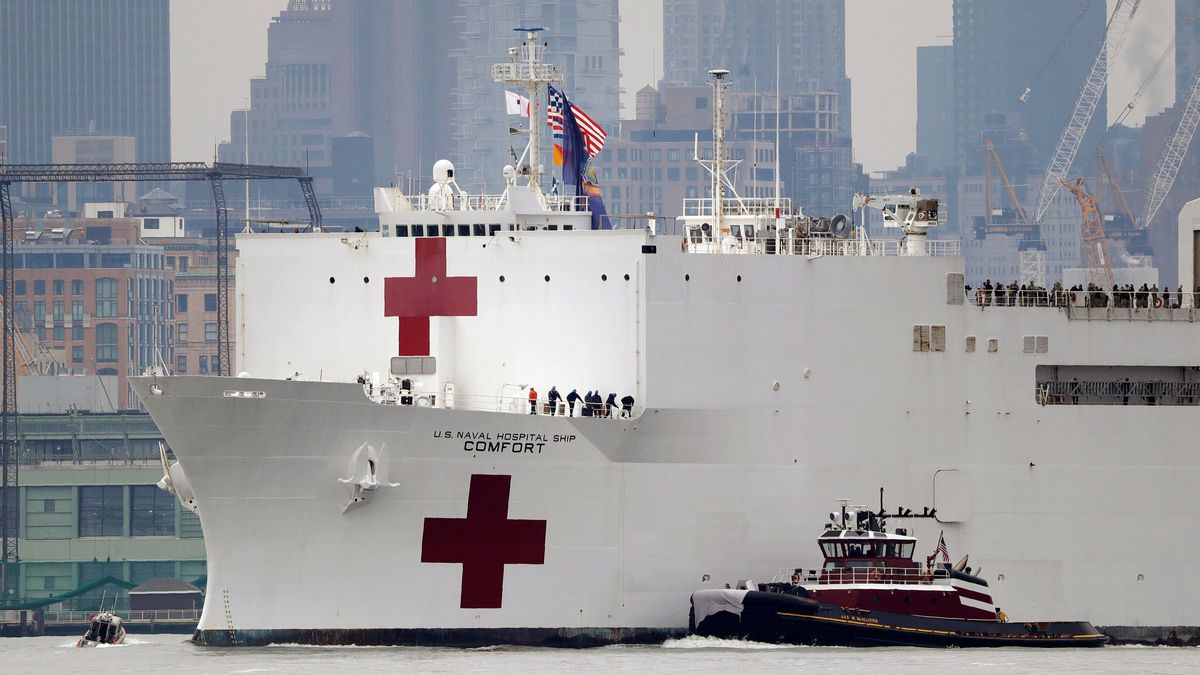
President Donald Trump announced the dispatch of a U.S. hospital ship to Greenland, citing a need for patient care on the remote Arctic island. In a post on Truth Social, Trump stated the vessel was “on its way!!!” to assist those unable to receive medical help locally. While specific details were scarce, the announcement involved a “great” ship, strongly implying the deployment of one of the U.S. Navy’s two large hospital ships, likely the USNS Comfort, known for its extensive medical facilities.
This move by the U.S. risks escalating tensions with Denmark, a NATO ally, especially given Trump’s previous controversial overtures to acquire Greenland, which is an autonomous territory within the Kingdom of Denmark. His repeated, albeit sometimes veiled, threats to annex the strategically vital island, even by force, have already caused significant diplomatic friction between Washington and European capitals. Countries like Germany, the UK, and France have publicly supported Denmark’s rejection of any annexation.
Despite the proposed deployment, questions immediately arose regarding the necessity and coordination of such an initiative. Greenland, with a population of just under 57,000, has not reported any major medical crisis warranting a hospital ship with a capacity of 1,000 beds and 80 ICU beds. Furthermore, it remained unclear whether the U.S. had consulted with either the Danish government in Copenhagen or the autonomous Greenlandic government in Nuuk before Trump’s announcement. The timeline also seemed ambiguous, as outfitting a hospital ship with full medical staff typically takes significant preparation, despite Trump’s assertion that it was already en route.
Adding to the intrigue, a U.S. Navy sailor was recently medically evacuated from a U.S. submarine by Danish forces near Nuuk, Greenland’s capital. The submarine made the unusual move of surfacing close to shore, a rare public display for a typically clandestine operation. This incident underscored the strategic importance of Greenland’s waters, which are becoming increasingly accessible due to melting ice, creating critical choke points between Russia, Europe, and North America—an area where China also seeks to expand its influence. The medical emergency highlights existing challenges in regional healthcare, though the capacity of a full hospital ship far exceeds current reported needs.
Source: Read Original
